Beyond Tokenization: Deal Box's Vision for Programmable Private Markets
5 min read

Beyond Tokenization: Deal Box's Vision for Programmable Private Markets


Blockchain
/
Sep 30

A new website. A deeper vision. Connecting how private companies raise capital with how financial assets operate.

On July 15, DTCC converted assets held at the Depository Trust Company into tokens and used them in live production trades. More than 30 firms took part, including BlackRock, Goldman Sachs and J.P. Morgan. The full DTCC Tokenization Service launches in October. DTC provides custody for securities valued at $114 trillion.

Public markets are getting new rails. Private markets still run on scattered documents, separate ownership records and manual work between systems. A company that closes a financing today often has nothing connecting the raise to what comes next.

Raising capital is one milestone in the life of a private company. What follows, managing ownership, communicating with investors, administering financial rights and making distributions, can last for years. Those activities should be connected.

That is the idea behind the new Deal Box website and our continuing work toward programmable capital: financial assets supported by digital records, approved rules and connected workflows throughout their lifecycle.
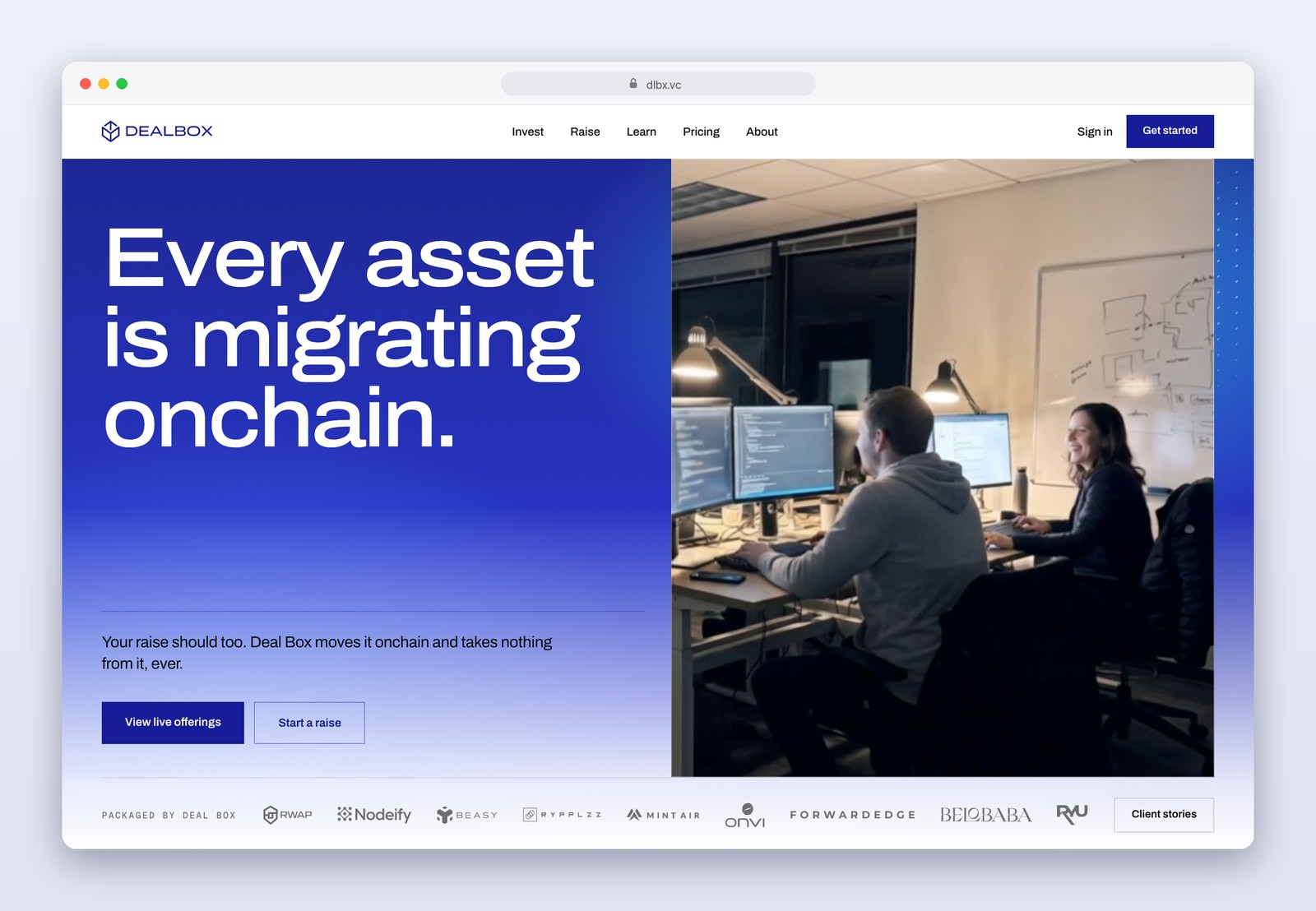
The new Deal Box homepage: Every asset is migrating onchain.

Capital formation is the beginning

I founded Deal Box in 2016 with a practical aim: help companies prepare to raise capital and give investors clearer information to evaluate what they were being offered. That foundation still anchors our work. The larger opportunity sits in what happens after the investment.

Private market transactions tend to involve scattered documents, separate ownership records and repeated manual work. Companies and investors move between systems that each hold only part of the picture.

Deal Box brings offering portals, investor relationship management, data rooms and document signing into one connected experience. The new site puts the investor view up front. Open offerings sit on one page, and each company's own records are there to read before anyone invests.
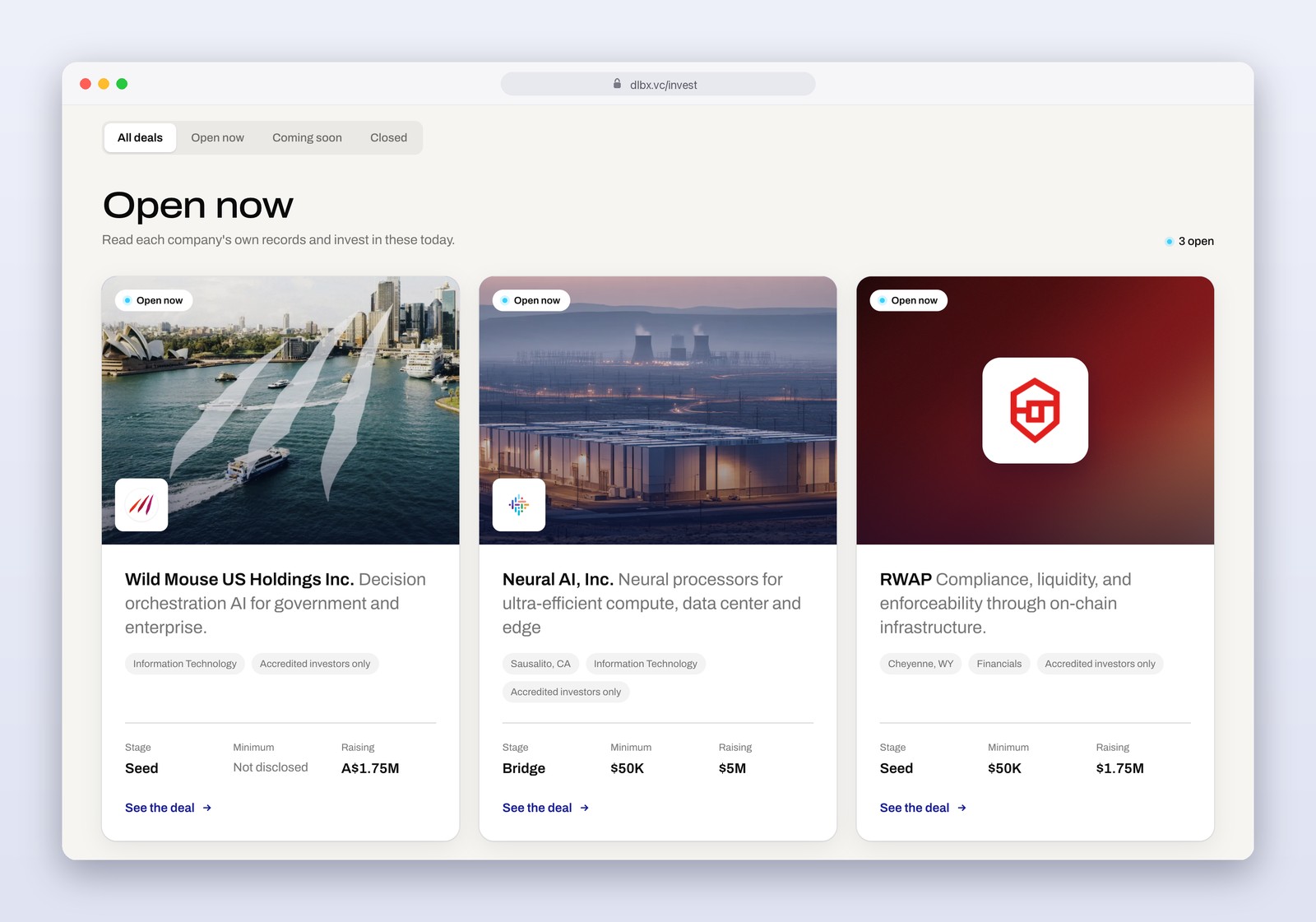
Open now: three open offerings on the Deal Box invest page.

The company side runs on the same logic. A founder's data room opens to investors who have signed the NDA, and only to the files the founder approved. Read tracking shows who got in and what each of them opened, so a founder can see who is serious before the first call.
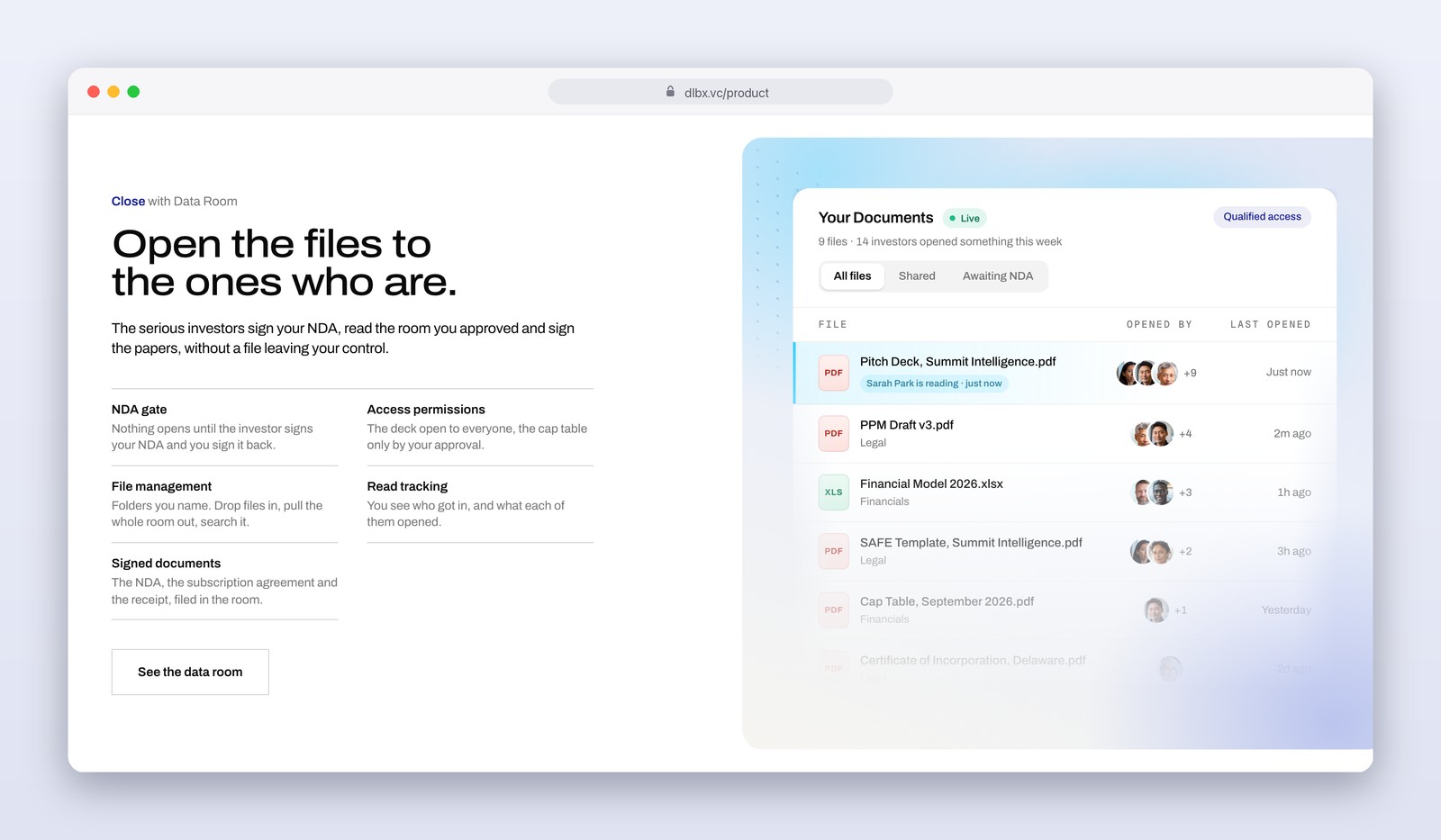
Open the files to the ones who are: NDA gate, access permissions and read tracking in the Deal Box data room.

Those capabilities help companies organize financing materials, manage investor engagement and present opportunities more clearly. They also lay the foundation for the next stage: the records, instructions, reporting and payment workflows that attach to a private financial asset.

Tokenization changes representation. Programmable capital changes operations.

Tokenization gives an asset a digital representation, and the market has started producing plenty of them. RWA.xyz tracked $38.76 billion in tokenized real world assets on September 3. What a representation enables matters more than how many exist.

Can ownership records stay connected to the governing documents? Can transfer requests be checked against approved requirements? Can verified financial information support distribution calculations? Can investors receive clearer reporting?

Programmable capital connects financial assets to software that can carry out approved instructions, subject to the underlying agreements and applicable requirements. The agreement establishes the rights. Technology supports their administration.

A digital token alone does not create enforceable rights, make an investment liquid or improve a company's performance. The opportunity comes from connecting the asset to useful, dependable operations.

A practical example: revenue participation

Take an investment that gives its holder the right to receive a defined portion of a company's revenue. The agreement specifies how revenue is measured, how payments are calculated, when distributions occur and what information investors receive.

Connected digital workflows could bring together:

  • Verified financial information
  • Calculations based on the agreement's terms
  • Investor ownership and eligibility records
  • Approved payment instructions
  • Reporting and distribution histories

For the company, that could mean a more consistent process. For the investor, a clearer view of what was owed, what was paid and why. Turning a defined financial arrangement into operations that are easier to administer, track and understand is what I mean by programmable capital.

Connecting complementary capabilities

Building this takes capabilities across capital formation, enterprise strategy, payments, infrastructure, identity and research. My broader ecosystem vision brings together complementary work across independent businesses and technologies:

  • Deal Box: Investment packaging and capital formation technology
  • Token Clear: Enterprise value intelligence, strategy and activation
  • Orobit: Bitcoin native infrastructure for programmable applications and tokenized assets
  • SQRL: Payments and money movement
  • BlendFi: A vision for connectivity between traditional and digital financial services
  • True I/O, UCID and BTC Names: Identity, verification and addressing technologies
  • Pando Research: Research and market intelligence

Deal Box remains a separate company. Each business is responsible for its own services, and connections across this ecosystem depend on development, validated integrations and applicable requirements.

The new site draws the stack in four layers: formed by Deal Box, recorded on an independent register, made programmable by Orobit and settled on Bitcoin. Formation, programmability and settlement are live today. The register, where ownership is kept by a separate company, is marked as coming soon. I would rather show that gap than hide it.

The work ahead is to connect these capabilities around the practical needs of issuers and investors.

Build around the entire asset lifecycle

My ambition for Deal Box is to help build infrastructure for tokenized private markets that works before, during and after a financing.

That starts with issuer readiness and investment packaging. It extends toward digital ownership records, approved transfer rules, reporting and financial workflows as the supporting capabilities are developed and integrated. I would judge progress by outcomes: better information, more consistent administration and a clearer connection between an investor's rights and the systems supporting them.

Deal Box charges issuers for technology and advisory services, takes no percentage of capital raised and charges investors no platform fees.

The new website introduces the platform available today and the direction we are building toward. Private capital has a long lifecycle. The infrastructure supporting it should have one too.

Explore the new Deal Box at dealbox.io.

Deal Box is not a registered broker dealer. Securities offerings are made solely through the applicable issuer's offering documents and eligibility requirements. Private investments involve substantial risk, including complete loss of capital. Tokenization does not guarantee liquidity or returns. Planned capabilities remain subject to development, integration and applicable requirements.

‍

‍

Beyond Tokenization: Deal Box's Vision for Programmable Private Markets
5 min read

Beyond Tokenization: Deal Box's Vision for Programmable Private Markets

Blockchain
Sep 30
/
5 min read

A new website. A deeper vision. Connecting how private companies raise capital with how financial assets operate.

On July 15, DTCC converted assets held at the Depository Trust Company into tokens and used them in live production trades. More than 30 firms took part, including BlackRock, Goldman Sachs and J.P. Morgan. The full DTCC Tokenization Service launches in October. DTC provides custody for securities valued at $114 trillion.

Public markets are getting new rails. Private markets still run on scattered documents, separate ownership records and manual work between systems. A company that closes a financing today often has nothing connecting the raise to what comes next.

Raising capital is one milestone in the life of a private company. What follows, managing ownership, communicating with investors, administering financial rights and making distributions, can last for years. Those activities should be connected.

That is the idea behind the new Deal Box website and our continuing work toward programmable capital: financial assets supported by digital records, approved rules and connected workflows throughout their lifecycle.

The new Deal Box homepage: Every asset is migrating onchain.

Capital formation is the beginning

I founded Deal Box in 2016 with a practical aim: help companies prepare to raise capital and give investors clearer information to evaluate what they were being offered. That foundation still anchors our work. The larger opportunity sits in what happens after the investment.

Private market transactions tend to involve scattered documents, separate ownership records and repeated manual work. Companies and investors move between systems that each hold only part of the picture.

Deal Box brings offering portals, investor relationship management, data rooms and document signing into one connected experience. The new site puts the investor view up front. Open offerings sit on one page, and each company's own records are there to read before anyone invests.

Open now: three open offerings on the Deal Box invest page.

The company side runs on the same logic. A founder's data room opens to investors who have signed the NDA, and only to the files the founder approved. Read tracking shows who got in and what each of them opened, so a founder can see who is serious before the first call.

Open the files to the ones who are: NDA gate, access permissions and read tracking in the Deal Box data room.

Those capabilities help companies organize financing materials, manage investor engagement and present opportunities more clearly. They also lay the foundation for the next stage: the records, instructions, reporting and payment workflows that attach to a private financial asset.

Tokenization changes representation. Programmable capital changes operations.

Tokenization gives an asset a digital representation, and the market has started producing plenty of them. RWA.xyz tracked $38.76 billion in tokenized real world assets on September 3. What a representation enables matters more than how many exist.

Can ownership records stay connected to the governing documents? Can transfer requests be checked against approved requirements? Can verified financial information support distribution calculations? Can investors receive clearer reporting?

Programmable capital connects financial assets to software that can carry out approved instructions, subject to the underlying agreements and applicable requirements. The agreement establishes the rights. Technology supports their administration.

A digital token alone does not create enforceable rights, make an investment liquid or improve a company's performance. The opportunity comes from connecting the asset to useful, dependable operations.

A practical example: revenue participation

Take an investment that gives its holder the right to receive a defined portion of a company's revenue. The agreement specifies how revenue is measured, how payments are calculated, when distributions occur and what information investors receive.

Connected digital workflows could bring together:

  • Verified financial information
  • Calculations based on the agreement's terms
  • Investor ownership and eligibility records
  • Approved payment instructions
  • Reporting and distribution histories

For the company, that could mean a more consistent process. For the investor, a clearer view of what was owed, what was paid and why. Turning a defined financial arrangement into operations that are easier to administer, track and understand is what I mean by programmable capital.

Connecting complementary capabilities

Building this takes capabilities across capital formation, enterprise strategy, payments, infrastructure, identity and research. My broader ecosystem vision brings together complementary work across independent businesses and technologies:

  • Deal Box: Investment packaging and capital formation technology
  • Token Clear: Enterprise value intelligence, strategy and activation
  • Orobit: Bitcoin native infrastructure for programmable applications and tokenized assets
  • SQRL: Payments and money movement
  • BlendFi: A vision for connectivity between traditional and digital financial services
  • True I/O, UCID and BTC Names: Identity, verification and addressing technologies
  • Pando Research: Research and market intelligence

Deal Box remains a separate company. Each business is responsible for its own services, and connections across this ecosystem depend on development, validated integrations and applicable requirements.

The new site draws the stack in four layers: formed by Deal Box, recorded on an independent register, made programmable by Orobit and settled on Bitcoin. Formation, programmability and settlement are live today. The register, where ownership is kept by a separate company, is marked as coming soon. I would rather show that gap than hide it.

The work ahead is to connect these capabilities around the practical needs of issuers and investors.

Build around the entire asset lifecycle

My ambition for Deal Box is to help build infrastructure for tokenized private markets that works before, during and after a financing.

That starts with issuer readiness and investment packaging. It extends toward digital ownership records, approved transfer rules, reporting and financial workflows as the supporting capabilities are developed and integrated. I would judge progress by outcomes: better information, more consistent administration and a clearer connection between an investor's rights and the systems supporting them.

Deal Box charges issuers for technology and advisory services, takes no percentage of capital raised and charges investors no platform fees.

The new website introduces the platform available today and the direction we are building toward. Private capital has a long lifecycle. The infrastructure supporting it should have one too.

Explore the new Deal Box at dealbox.io.

Deal Box is not a registered broker dealer. Securities offerings are made solely through the applicable issuer's offering documents and eligibility requirements. Private investments involve substantial risk, including complete loss of capital. Tokenization does not guarantee liquidity or returns. Planned capabilities remain subject to development, integration and applicable requirements.

‍

‍