
The Week Wall Street Stopped Pretending

Most weeks the news cycle moves the market. Once in a while the market has already moved, and the news cycle spends the next five days catching up. That is what happened in the seven days ending April 28.
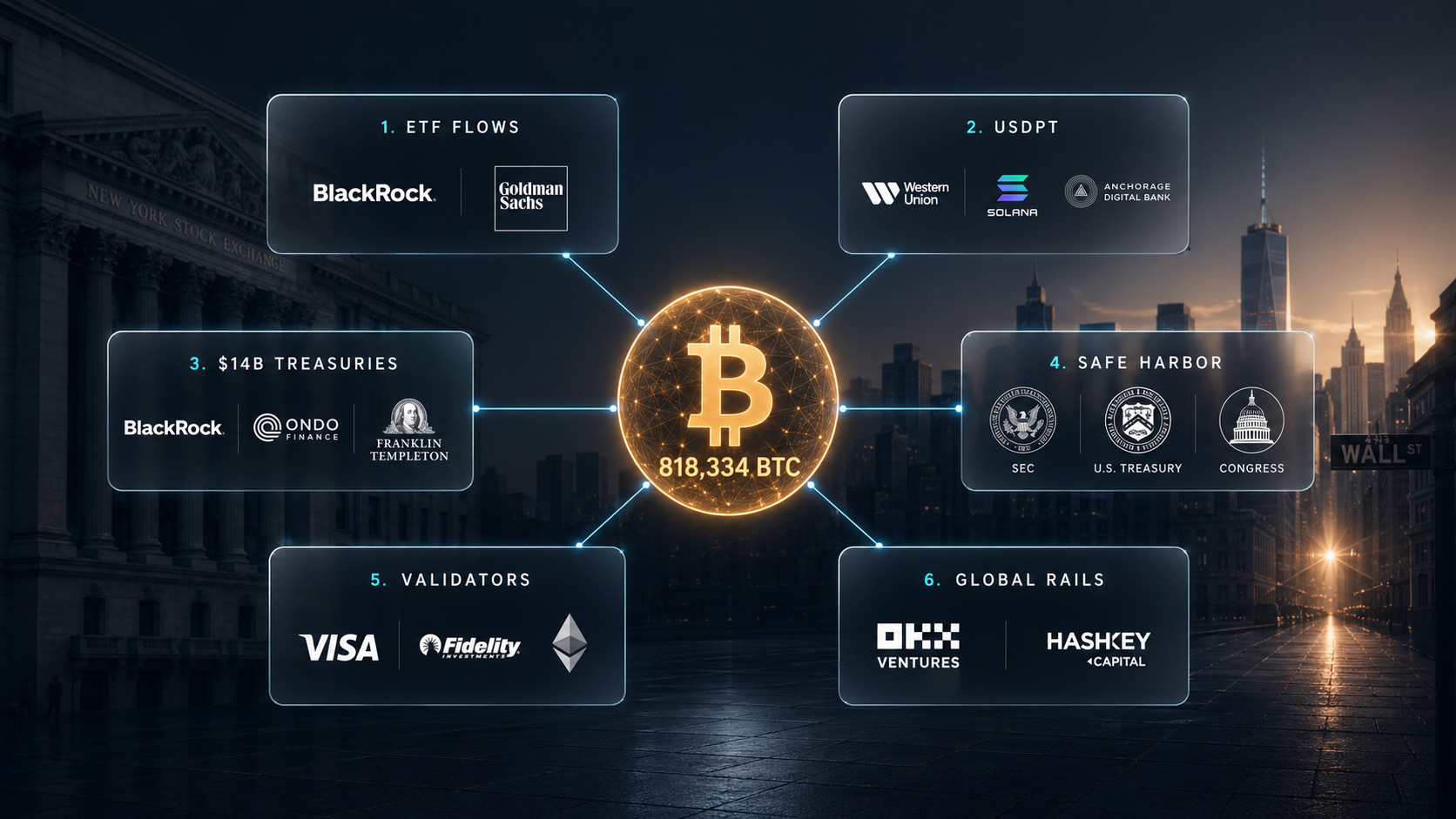
Strategy surpassed BlackRock as the world's single largest Bitcoin holder. Goldman Sachs filed its first proprietary Bitcoin ETF. Western Union announced a stablecoin launching on Solana next month. Tokenized U.S. Treasuries crossed $14 billion. The SEC exempted DeFi front-ends from broker-dealer registration for the next five years. Bitcoin spot ETFs posted their fourth consecutive week of inflows, with April pulling in more than $2.4 billion, almost double March.
None of these events happened in isolation. Read together, they describe an institutional migration that has moved past the theoretical and the early stages, and isn't going to reverse from here.
The Largest Holder on Earth
The headline number is this. Michael Saylor's Strategy now holds 818,334 BTC, worth approximately $63.5 billion at current prices, surpassing BlackRock's IBIT fund at 802,824 BTC.
Strategy added 34,164 BTC for $2.54 billion on April 20, then another 3,273 BTC for $255 million on April 27, funded through ATM equity sales and STRF perpetual preferred equity. The company is not slowing down. Saylor has publicly committed to a target of one million Bitcoin.
I have said before that corporate treasury adoption of digital assets tends to follow a predictable pattern. One company validates the thesis. A cohort follows. Then the infrastructure makes it inevitable. Strategy is still in the first phase for most boardrooms, but the scale of their position now exceeds the world's largest asset manager's spot ETF. That makes the conversation impossible to avoid in any serious treasury discussion.
When a single public company holds more Bitcoin than BlackRock's flagship product, the framing has to shift. What Strategy is running is no longer a speculative position. It is a treasury strategy operating at institutional scale, with governance, public reporting, and a capital structure specifically designed to support it.
Goldman Enters the ETF Complex
Goldman Sachs filed for a Bitcoin Premium Income ETF on April 15. It is their first proprietary Bitcoin product.
The structure allocates 80 percent or more to spot Bitcoin ETPs like IBIT, with covered call options sold against the position to generate monthly income. Analysts have described it as "boomer candy," a product designed to make Bitcoin palatable to the wealth management and retirement advisory channels that Goldman dominates.
That characterization is more revealing than dismissive. Goldman isn't building this for crypto traders. They are building it for the advisor sitting across the desk from a 58-year-old client with a $4 million portfolio who wants exposure to Bitcoin but also wants income. That distribution channel dwarfs anything the crypto-native ecosystem has built.
The SEC has a 75-day review window, putting the earliest launch in late June. The signal matters more than the timing here. Goldman doesn't file products to test the water; they file them once the testing is done and the demand is already there.
Meanwhile, BlackRock's IBIT continues to absorb capital at a remarkable rate: $906 million in the week of April 13-17, and another $733 million the following week. That is 91 percent of weekly flows. There have been no outflow days since April 9. Total Bitcoin ETF AUM now exceeds $102 billion.
The ETF wrapper has stopped being a distribution experiment for digital assets. It is now a capital formation engine.
Western Union Brings Stablecoins to Mainstreet
Western Union announced that USDPT, its own stablecoin built on Solana and issued by Anchorage Digital Bank, launches in May 2026.
A 175-year-old payments company is launching a stablecoin on Solana and using it to replace SWIFT settlements between its agent network. That sentence is worth sitting with for a moment.
The company is also rolling out a Digital Asset Network connecting crypto wallets to Western Union's retail infrastructure, and a USD Stable Card for global consumers later this year.
This isn't a pilot, and it isn't a press release announcing a "strategic exploration." It is a legacy payments giant migrating its core settlement infrastructure to blockchain rails because the rails are faster, cheaper, and more transparent than the system it has been running for the past 175 years.
When I talk about markets migrating toward rails that make capital easier to move and simpler to settle, this is what I mean. Not as an abstraction or a thesis, but as a product shipping next month.
Tokenized Treasuries: $14 Billion and Accelerating
Tokenized U.S. Treasuries have reached $14 billion, a 37x increase from early 2023. BlackRock's BUIDL fund leads at over $2.5 billion. Ondo Finance manages $1.4 billion across USDY and OUSG. The top five products capture roughly 85 percent of the market.
Total on-chain tokenized asset value, excluding stablecoins, stands at $27.65 billion as of early April, up 4 percent over 30 days. Represented asset value (the total underlying assets in the tokenization ecosystem) sits at $441 billion, up 31.6 percent over the same period.
Context matters here. Tokenized treasuries did not exist at institutional scale three years ago. Today they represent a $14 billion market growing at a pace that points to $30 billion or more by year-end. The products are being built by the same institutions that define mainstream asset management: BlackRock, Franklin Templeton, and Ondo.
This is the tokenization thesis moving from forecast onto the balance sheet.
The Regulatory Architecture Is Materializing
Three regulatory developments this week deserve to be read as a connected story rather than as isolated events.
First, the SEC's DeFi front-end exemption. The Division of Trading and Markets issued a staff statement providing a five-year safe harbor for "Covered User Interface Providers," which covers websites, browser extensions, and wallet-embedded tools. Users maintain self-custody. Interfaces can charge fixed neutral fees. No broker-dealer registration is required through April 2031.
This is the SEC formally acknowledging that DeFi infrastructure serves a different function than traditional brokerage, and creating a regulatory pathway in place of an enforcement campaign. Under the prior administration, this category of activity would have been a target. Under Chair Atkins, it is a safe harbor.
Second, the CLARITY Act reached a stablecoin yield compromise. The White House Digital Assets Advisory Committee confirmed the breakthrough. Passive yields from simply holding stablecoins are prohibited, but rewards tied to payments, transfers, or platform usage are permitted. Senate Banking Committee markup is planned for late April. Senator Lummis describes the negotiations as "99 percent resolved."
Third, Treasury's FinCEN and OFAC proposed AML and sanctions rules for stablecoin issuers implementing the GENIUS Act's compliance provisions. Comments are due June 9. The compliance infrastructure is being built in parallel with the market infrastructure, which is the sequence institutional adoption requires.
When the SEC, Congress, and Treasury all move in the same direction within the same month, it stops being coincidence and starts being a regulatory architecture materializing in real time.
The DeFi Stress Test
Not everything this week validated the thesis.
KelpDAO was exploited for $292 million on April 18-19, the largest DeFi hack of 2026 to date. Attackers compromised RPC nodes powering KelpDAO's LayerZero bridge, minted 116,500 unbacked rsETH tokens, and used them as collateral to drain approximately $190 million from Aave. DeFi total value locked dropped $13.2 billion in 48 hours, with $8.45 billion exiting Aave alone.
The response was instructive. A cross-protocol recovery effort branded "DeFi United" has raised $160 million of a $200 million target. The Solana Foundation joined by lending USDT into Aave and announcing plans to bring the AAVE token to Solana. Arbitrum DAO, Mantle, and Aave DAO pledged over 85,000 ETH between them.
Separately, a class-action lawsuit was filed against Circle for failing to freeze $295 million in stolen funds from the Drift Protocol exploit. Those funds moved through Circle's CCTP bridge over eight hours, even though Circle had frozen 16 unrelated wallets in a separate matter just nine days earlier.
I want to be direct about what these events mean for the institutional thesis. Bridge exploits, RPC compromises, and custody failures are infrastructure problems, and they are solvable infrastructure problems. They do not invalidate the migration to blockchain rails any more than early internet security breaches invalidated e-commerce. They do show why institutional-grade custody, compliance-first infrastructure, and governance frameworks are non-negotiable prerequisites for corporate participation.
Companies that enter this space through governed, custodied, compliance-first channels aren't carrying this risk. The ones routing around governance are. That distinction sits at the foundation of the DAT framework.
The Global Picture
Two international developments round out the week.
Russia's State Duma passed a bill formally recognizing cryptocurrency as property and authorizing its use for cross-border trade settlements (specifically to circumvent Western sanctions) while maintaining a domestic payment ban. If approved, it takes effect July 1.
Vietnam is launching a five-year pilot program for licensed crypto trading in Q2 2026, with five exchanges shortlisted and $380 million in backing from OKX Ventures and HashKey Capital. Vietnam saw an estimated $200 billion in crypto activity through mid-2025.
And quietly, Fortune 500 companies are becoming blockchain validators. Visa is now one of 40 super validators on the Canton network. Fidelity launched a Decentralized Verifier Network on LayerZero. Sumitomo Corporation began validator operations across Avalanche, Ethereum, and Canton.
When Visa, Fidelity, and Sumitomo are running blockchain validator nodes, the "institutional adoption" conversation has moved past allocation and into infrastructure operation. These companies aren't just buying tokens anymore. They are operating the networks the tokens settle on.
The Market Snapshot
Bitcoin: $79,124, up 18 percent over the past month. Ethereum: $2,388. Total crypto market cap: approximately $2.6 trillion. Fear and Greed Index: 47 (Neutral), recovered from 29 (Fear) the prior week.
The Fed FOMC meeting runs April 28-29, the biggest macro catalyst for the week ahead. SEC Chair Atkins is expected to give his first major address on digital asset market structure at a crypto conference this week. Dubai RWA WEEK runs through May 1, with the flagship RWA Summit closing out the event.
What This Week Actually Tells You
Once you strip away the individual headlines, the pattern underneath is structural.
The largest corporate Bitcoin holder on earth just surpassed the largest asset manager's flagship ETF. Goldman Sachs is packaging Bitcoin for retirement advisors. Western Union is replacing SWIFT with a stablecoin on Solana. Tokenized treasuries are a $14 billion market that did not exist three years ago. The SEC is building safe harbors instead of enforcement actions. Fortune 500 companies are operating blockchain infrastructure rather than simply investing in it.
This is what I have been building toward since founding Deal Box in 2016. The thesis was never about any single catalyst. It was about the convergence, with regulatory clarity, institutional products, corporate treasury adoption, tokenization infrastructure, and global migration to programmable rails all arriving inside the same window.
That window is open.
The question every CFO, board member, and allocator reading this has to answer is whether they are positioned for the infrastructure era, or whether they are still debating whether it will arrive.
The market gave its answer this week.


Fintech
Newsletter.


