
Capital That Never Sleeps: How AI and Tokenization Are Reshaping Corporate Treasury


Recent moves by Uber, HSBC, DTCC, J.P. Morgan and Visa point toward financial infrastructure that can put capital to work more continuously.
A business can run around the clock while its money waits for the banking system to reopen.
Customers pay on weekends. Suppliers work across time zones. Cash needs change overnight. Treasury teams still have to manage investment redemptions, payment cutoffs and settlement schedules that keep different hours from the business they serve.
Companies pay for that gap. They hold liquidity buffers, leave money uninvested and arrange credit facilities partly because moving capital takes time. Tokenization gets much easier to evaluate once you start from those everyday constraints.
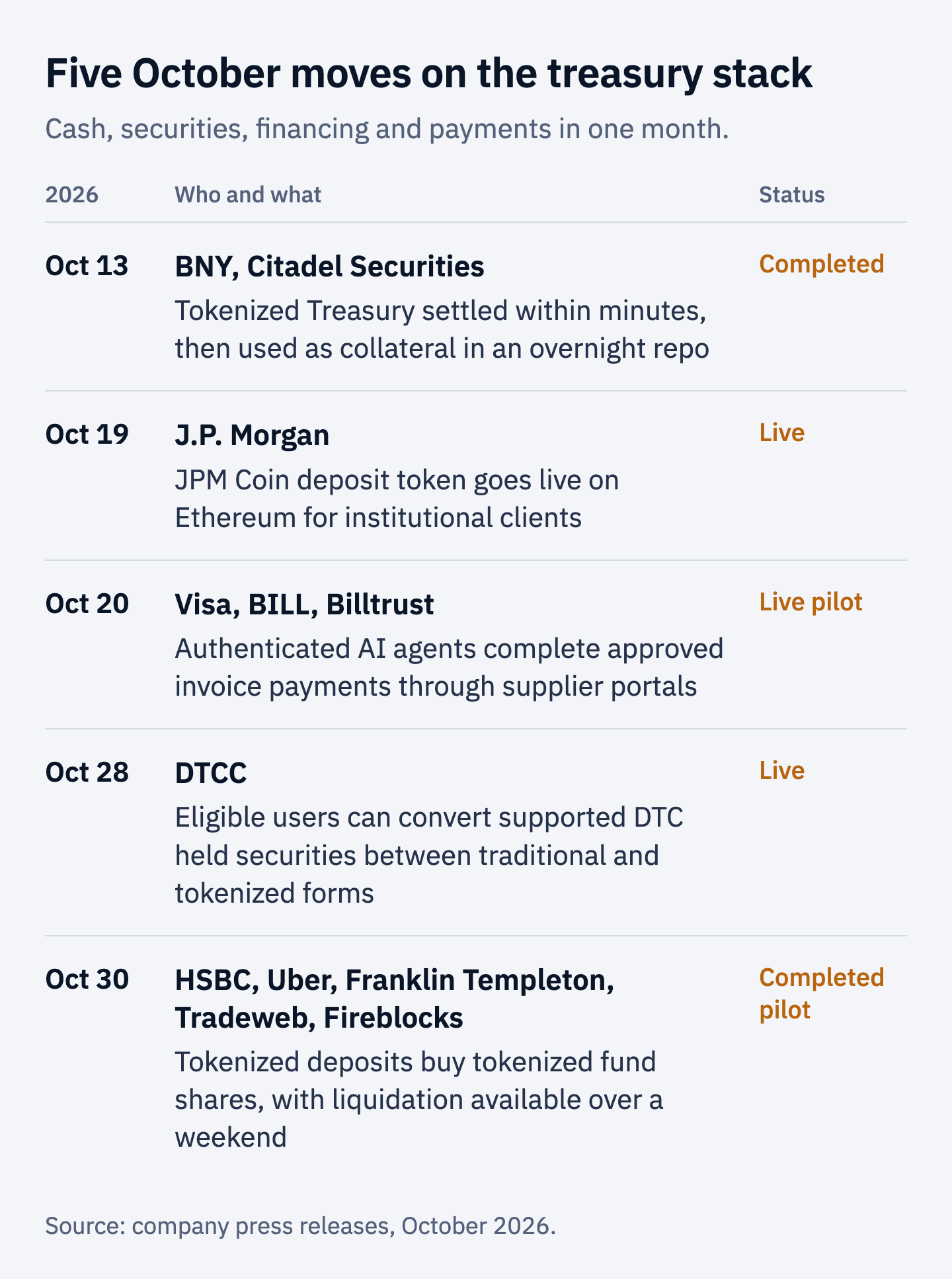
October brought five announcements that speak directly to them.
Uber puts the treasury opportunity into focus
On October 30, HSBC Bank USA announced a completed pilot with Uber, Franklin Templeton, Tradeweb and Fireblocks on the Canton Network.
Uber used HSBC tokenized deposits to buy Franklin Templeton tokenized money market fund shares on Tradeweb, with delivery versus payment settlement through Fireblocks. The pilot also gave Uber the ability to liquidate part of those holdings, including over a weekend, while continuing to earn yield.
The practical objective was straightforward: keep eligible cash earning yield for longer while retaining access to it when payments come due. Odette Rodrigues, Uber's VP of corporate finance, treasury and capital markets, called the pilot "an important first step in our journey towards a more efficient, 24/7 model for managing our working capital."
This remains a pilot. It still gives corporate executives a concrete reason to pay attention, because a treasurer can measure the value of blockchain in familiar terms: how much cash must sit idle, how quickly investments can fund payments and how reliably the process operates.
Tokenized assets are entering financing workflows
BNY and Citadel Securities demonstrated another part of the picture on October 13.
Citadel Securities bought a two year U.S. Treasury note through BNY on Tradeweb. A tokenized representation was recorded on BNY's private digital ledger and settled within minutes, ahead of the standard T+1 cycle. Citadel Securities then used it as collateral in an overnight triparty repo, with BNY providing the cash. BNY describes this as the first use of tokenized assets on a major triparty repo platform.
Purchase, settlement and financing ran as one connected workflow. An asset becomes more useful when its owner can deploy it efficiently within the financial activities that already matter to them.
The supporting rails expanded in the same month.
J.P. Morgan brought its JPM Coin deposit token to Ethereum on October 19, its second public blockchain after Base, for institutional clients. J.P. Morgan Asset Management launched tokenized money market funds on Ethereum earlier this year, so the same group now has bank deposits and fund shares on one network. HSBC's tokenized deposits and JPM Coin share a starting point, because the cash leg is bank deposit money, a form of cash corporate treasurers already hold.
DTCC launched its tokenization service on October 28, allowing eligible users to convert supported DTC held securities between traditional and tokenized forms. Twenty DTC participants have signed agreements to access it. The service runs on the Canton Network and DTCC's private Besu network, with more networks due in 2027. DTC's more than $114 trillion in custody describes the institution's scale. It does not mean that amount has been tokenized.
These developments put more of the components for programmable finance into operational use.
AI introduces a new decision layer
Faster settlement addresses one problem. Deciding how to use capital addresses another.
A treasury team must understand upcoming obligations, available liquidity, investment restrictions, counterparty exposure and approval requirements before moving money. AI can help analyze those inputs, identify exceptions and recommend actions. Authorized execution requires an additional foundation: verified identity, explicit permissions and a record of what happened.
Visa's October 20 announcement with BILL and Billtrust shows where that line sits. In their live pilot, authenticated AI agents complete approved invoice payments through supplier portals, using tokenized payment credentials in place of shared logins, with controls tied to the buyer's approved instructions. Visa is explicit about who decides: "The agent only executes eligible payments that have already been approved by the buyer."
That is one payment workflow, and autonomous treasury management has not arrived. The pilot does show AI moving beyond analysis into controlled financial activity.
My view is that connecting these capabilities could define the next phase of programmable capital:
- Intelligence that identifies an opportunity
- Policies that determine what is permitted
- Infrastructure that carries out approved actions
Measure the value in business terms
Consider a hypothetical company with $100 million in average cash balances.
Suppose an improved treasury process allows it to keep an additional $20 million invested, on average, rather than idle. At an assumed 4% annual yield, that represents $800,000 in additional annual gross income before fees, taxes and implementation costs.
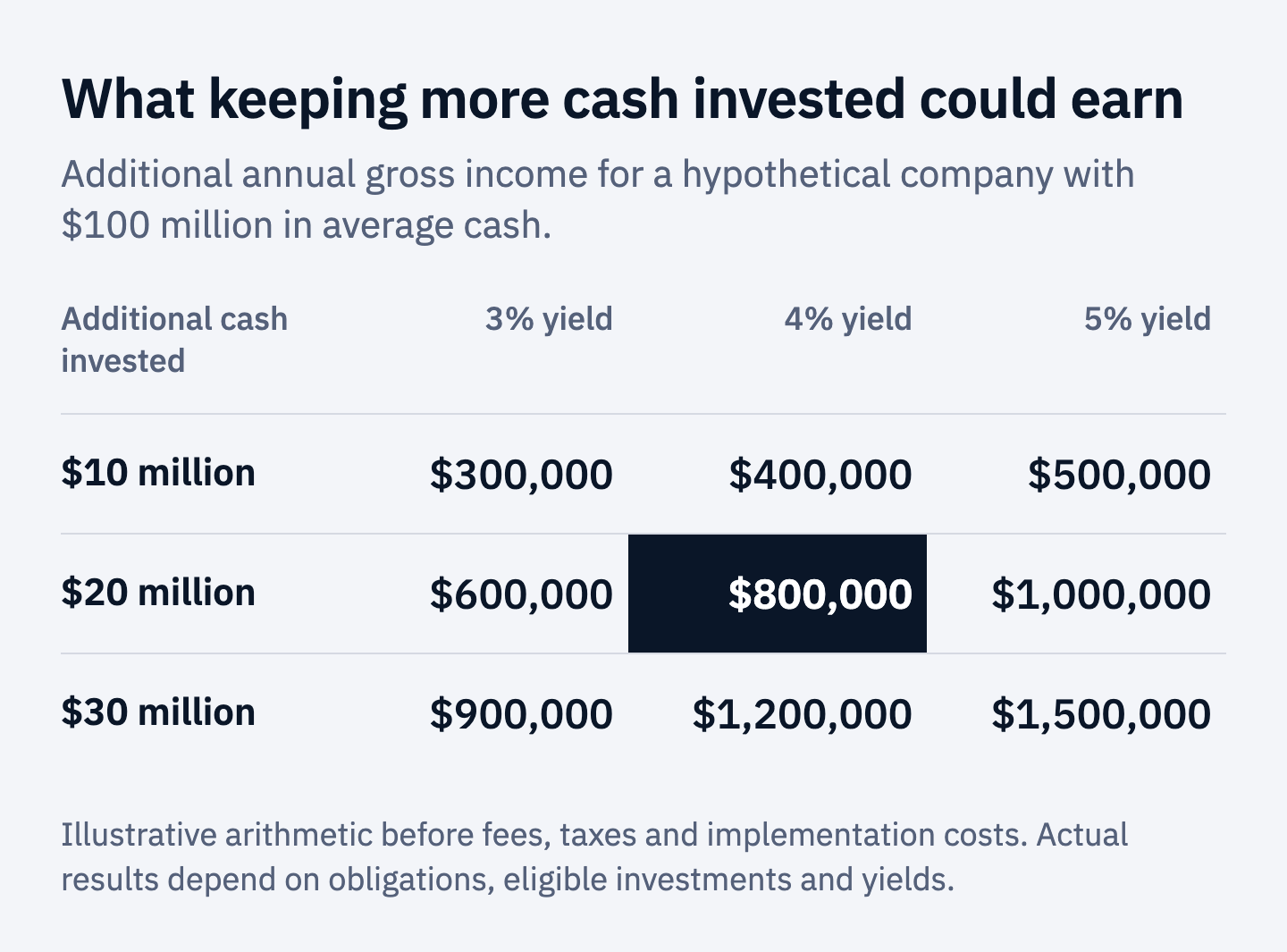
These figures illustrate the arithmetic and forecast no return. The result for any company depends on its obligations, eligible investments, actual yields and operational constraints. Even so, a CFO can run this calculation on real balances long before committing to new infrastructure.
The same discipline should apply to tokenized real world assets. A digital representation becomes commercially meaningful when it improves a specific function: administration, payment processing, ownership verification, collateral use or access to financing.
Where Token Clear fits
This is the opportunity I see for Token Clear: helping enterprises identify where financial friction affects performance and evaluate which changes could produce measurable value. I am not claiming any connection between Token Clear and the companies named above.
Before implementing new infrastructure, a company needs answers to five questions:
- Where is capital sitting idle?
- Which constraints create that requirement?
- What could change?
- What would implementation cost?
- How would management verify the result?
Enterprise intelligence is the starting point for that reason. The technology decision should follow a clear understanding of the economics.
The next test is performance
In my previous article, I described programmable capital as connecting financial assets with approved rules and useful operations throughout their lifecycle.
October gave that idea a more tangible expression. Treasury investments have been tested alongside payment needs. Tokenized collateral has supported financing. Authenticated AI agents are executing approved transactions.
These are early and distinct implementations. Their broader convergence remains an opportunity to build.
For founders, CFOs and family offices, the question is becoming more practical: where could better intelligence and more connected financial infrastructure improve the way capital works?
That is where I believe the next durable businesses will be built.
The views expressed here are my own and are provided for informational purposes only. Nothing in this article constitutes an offer to sell or solicitation to purchase any security, or investment, tax or legal advice. The treasury example is hypothetical and does not predict any result.


Fintech
Newsletter.


